CALENDULA HERBAL MONOGRAPH
Botanical name: Calendula officinalis.
Common names: Calendula, Pot marigold.
Family: Asteraceae.
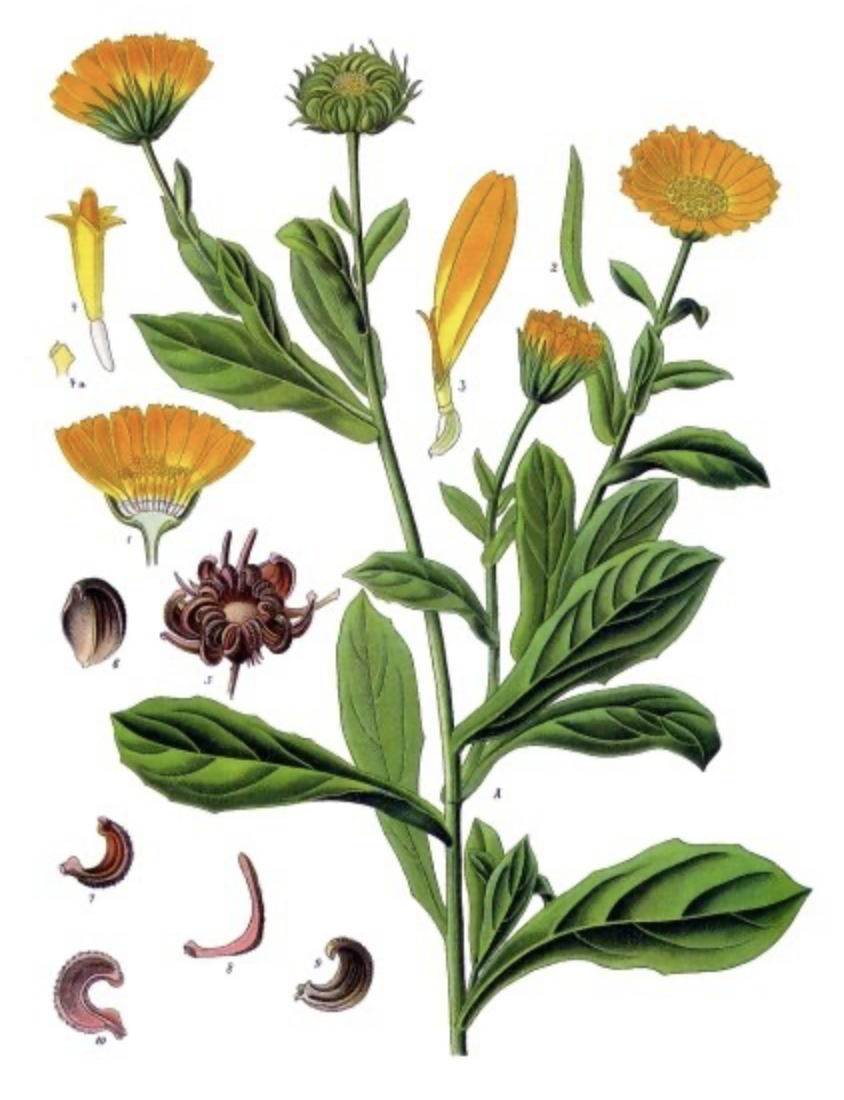
Description: Calendula officinalis is a perennial plant that can grow up to a metre in height. The green alternative, petiolate, oblong leaves are aromatic, hairy and lightly toothed. The flowers are bright yellow or orange, forming a thick flower head up to 7cm in diameter. Native to Egypt and the Mediterranean, and naturalised globally in temperate climates, Calendula grows very easily in many different habitats but prefers constant sunshine.
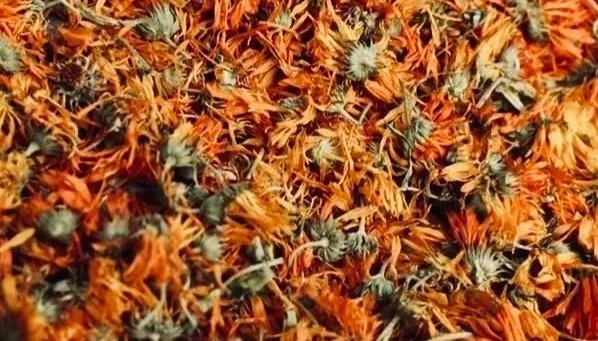
Parts used: It is important to use the entire flower and not just the petals, as the flower base contains most of the aromatic and resinous properties which are responsible for it’s medicinal actions.
Energetics: Warm, drying.
Taste: Bitter, slightly salty.
Constituents: Bitter resin (calendulin & caledin), carotenoids ,flavonoids (isorhamnetin, rutin and quercetin) & quercitin), sesquiterpenoids mucilage, polysaccharides, xanthophyls & carotenoids, volatile oils. triterpene & steroidal saponins, (oleanolic acid glycosides), triterpene alcohols (faradiol 3-monoesters).
Actions: Astringent, antiseptic, anti-fungal, anti-inflammatory, anti-spasmodic, bitter tonic (cholagogue), emmenagogue, immune tonic, lymphagogue.
Folklore & traditions: Calendula has a long history of use, particularly as a topical application to wounds, ulcers, eczema and burns, and to stop bleeding. It is traditionally utilised as a first aid treatment as a balm, poultice or compress. Its effectiveness as a compress at healing bullet wounds was reported in the American war in 1886. Traditionally, Calendula was put into soups and stews in the wintertime for its immune and lymphatic stimulant properties tom ward off colds and flu.
Calendula has been used historically to induce a sweat during a fever, induce menstrual flow and cure jaundice. Calendula flowers were known as “poor man’s saffron”, as they were used to colour foods and fabrics, and are a colourful addition to salads and soups.
Medicinal uses: Skin - Calendula officinalis provides antioxidant protection whilst soothing skin & reducing the histamine (allergy) response in the body. Antiseptic, anti-fungal, anti-inflammatory, & antibacterial, Calendula is a perfect herb for healing wounds, blisters, burns, cuts, bites, cold sores & chicken pox, soothing eczema, itching & nappy rash. Calendula infusion is a powerful mouthwash for bleeding gums and throat infections, and as an eyewash.
Immune System - Calendula is gentle immune system tonic, which builds up the vital heat of the body and regulates fluid metabolism by clearing stagnation, detoxifying and keeping eliminatory channels open and detoxifying. It helps keep any pathogenic bacteria at bay. such as coughs, colds and flus, specifically when accompanied by fever and swollen lymph nodes. Calendula is specific for “lingering unresolved infections.” such as respiratory infections, fevers and the common cold.
Lymphatic system - A renowned lymphatic alterative, Calendula open up the channels of elimination for the body, including the lymphatic, digestive and circulatory systems. Calendula has a systemic anti-inflammatory action, and is beneficial to stimulate the drainage of enlarged, swollen and inflamed lymph nodes. It is a specific herb for the lymphatics in the breast and pelvic tissues.
Digestive System & Antibiotic Trauma - As a bitter, Calendula stimulates bile production, aiding digestion and nutrient absorption and rebuilding gut health. The flavonoids and triterpenes have an anti-inflammatory action and help calm digestive irritation. Unlike broad-spectrum antibiotics, Calendula has a selective antimicrobial effect, helping keep harmful bacteria in check while allowing beneficial flora to repopulate. This makes it ideal for the post-antibiotic recovery phase. Calendula is beneficial for disease and infections in the upper digestive tract, including stomach ulcers, heartburn, food intolerance and leaky gut syndrome.
Liver and Gallbladder - Bitter tonics have a stimulant effect upon the liver, increasing its detoxification capacities and often increasing production of bile secretion by the gallbladder. This is beneficial for the metabolism and digestion of fats and oils, as well as general digestive insufficiency. This typically results in fluids being drained from the body, which ultimately leads to a constitutional net drying effect. This is critical to understand about bitters! Thus we see Calendula assists in draining stagnant fluids through a constitutional bitter action on the liver, gallbladder, and entire gastrointestinal tract. This is beneficial when treating jaundice, liver disease and for detox from drugs and pharmaceutical medications.
Female Reproductive System - As an emmenagogue, Calendula has a reputation of helping delayed menstruation and painful periods. The steroidal saponins in Calendula have mild phytoestrogenic activity, decrease tissue swelling, and along with flavonoids decrease inflammation. Calendula is a specific remedy for the uterus.
Chakra: Solar plexus.
Astrological correspondence: Sun.
Cautions & contraindications: Calendula is a mild and safe plant for internal consumption for all ages. Due to its emmenagogue effects (see Female Reproductive System above), it is to be avoided for internal use during pregnancy. Topical use during pregnancy is safe.
SHOP CALENDULA HEALING BALM HERE.
SHOP RECOVERY TEA WITH CALENDULA HERE.
SHOP CALENDULA & MANDARIN LIP BALM HERE.
References: Ayales, Adriana. The Herbal Astrology Oracle, 2022.
Gladstar, Rosemary. Family Herbal, 2001.
Hardin, J & Rose, K. Materia Medica : Profiles & Uses of Herbs, 2016.
Mills, Simon. The Essential Book of Herbal Medicine, 1991.
Tierra, Michael. Planetary Herbology, 1970.
Wood, Mathew, The Earthwise Herbal. A complete guide to New World Medicinal Plants, 2011.