HORSETAIL HERBAL MONOGRAPH
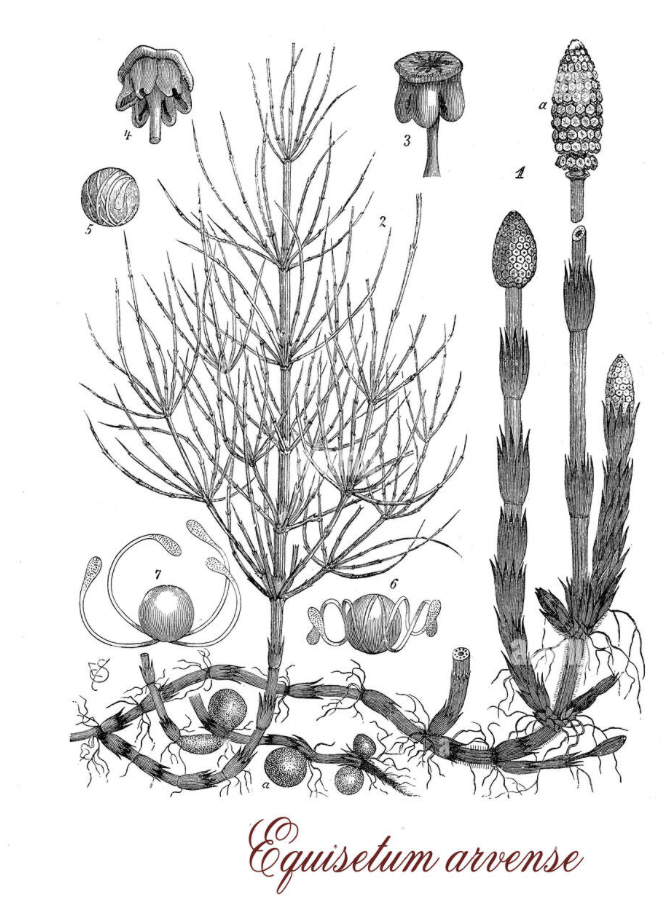
Botanical name: Equisetum arvense.
Common names: Horsetail, Shavegrass, Scouring Rush.
Family: Equisetaceae. Horsetail is the only living family within the order Equisetales and is closely related to ferns.
Description: Equisetium belongs to a family of vascular plants that reproduce by spores rather than seeds. It is a primitive, non-flowering perennial plant and a "living fossil" that reproduces via spores. It has distinct hollow, jointed and ribbed stems packed with high amounts of silica, and extensive, deep underground creeping rhizomes that form dense colonies. Horsetail thrives in damp areas, wetlands and riverbanks worldwide. It is highly resilient and often considered an aggressive weed because its deep rhizomes make it difficult to eradicate.
Parts used: Aerial parts—green stems and branches.
Energetics: Cool, dry.
Taste: Salty.
Constituents: Silica (7.5%), silicic acid (14% - Horsetail has one of the highest plant based sources of silica in the world), flavonoids (apigenin, kaempferol, luteolin, quercetin, epuicetrin), polyphenolic compounds, caffeic acid derivatives, alkaloids (nicotine, palustrine, palustrinine), sterols (cholesterol, isofucosterol, campesterol), thiaminase (an enzyme that breaks down thiamine), minerals (calcium 1.7%, manganese, magnesium, phosphorus and potassium 1.8%).
Actions: Alterative, anti-inflammatory, antimicrobial, astringent diuretic, trophorestorative, nutritive, vulnerary, uterine system tonic, integumentary system tonic.
Folklore & traditions: As one of the oldest living plants on Earth, dating back over 300 million years, Horsetail carries cellular the memory of the earliest expressions of life. All cultures where Horsetail was native have historically used it as a food and medicine - cooking it like a vegetable and eating the new shoots raw in spring. The name “Scouring Rush”refers to the tradition of utilising Horsetail to scour pots and pans at the river. Horsetail contains abundant amounts of silica as well as calcium, magnesium, phosphorus and potassium. These minerals, when regularly consumed, can strengthen the integumentary system which includes bones, connective tissue (fascia), skin, hair, nails, and teeth.
In ancient Greece and Rome, physicians used Horsetail to stop bleeding, heal wounds, strengthen bones, and improve kidney health. Traditionally used to treat ‘hay fever’, toenail fungus and to help to bring foreign or dead substances to the surface of the body. Its high silica content made it a staple tool for physical recovery, bone and tissue regeneration.
Horsetail’s ancient energy is associated with endurance, grounding, protection, regeneration, and strengthening of the human biofield. Horsetail nourishes the body while strengthening the subtle energetic layers that surround and protect the human being.
Medicinal uses: Musculoskeletal - One of Horsetail’s primary functions is to support the structural health of the bones and connective tissue. It is indicated for the treatment of osteoporosis and other disorders concerning the degeneration of bones, ligaments and tendons, and it is a specific herb for bone density loss that is associated with menopause. As well as promoting tissue regeneration, horsetail reduces inflammation. Much of the bone healing properties of this herb are attributed to its high mineral content, namely silica, which is important for healing, bones, ligaments and tendons. It is also rich in calcium, manganese and potassium. Silica also increases absorption and uptake of calcium. Horsetail has been shown to increase bone cell growth as well as helping to prevent risk of infection in the healing process. Horsetail can be used both internally and topically together for fractured bones.
Remineralise bones - Horsetail is one of the richest natural sources of bioavailable silicon (silica) - a trace element intimately linked to bothphysical and energetic well-being. Physically, silica strengthens skin, bones, hair and nails, repairs connective tissue, supports collagen production, improves elasticity and cellular regeneration. Horsetail works by promoting the activity of osteoblasts - cells which play a key role in the formation of new bone - whilst also reducing the activity of osteoclasts (cells which break down bone), andhas been shown in studies to improve bone density. Due to the speed at which some herbal medicines can heal bone, it is important to have confirmation from orthopaedic doctors that the bone is correctly aligned, and does not require resetting, before taking herbs to support repair.
Urinary system tonic & diuretic - Horsetail has an affinity with the urinary system, helping improve the tone of urinary mucous membranes. The astringent and styptic actions stimulate toning and strengthening of capillaries to reduce inflammation and stop bleeding.
Horsetail is also a mild diuretic that increases the removal of toxins via the urinary tract, making it useful to treat cysts, ulcers and inflammation in the urinary tract. Horsetail strengthens the bladder and is useful in chronic recurring bladder and urinary tract infections and cystitis. An infusion or decoction of horsetail taken internally helps with kidney stones and oedema by gently detoxifying and removing waste products from the body.
Horsetail is also sometimes used to rebuild or support the structural health of the uterus or bladder in prolapse, as it helps to strengthen the muscles and connective tissue. This may also be helpful for incontinence issues, and in reducing symptoms of other urinary tract symptoms, including overactive bladder, nighttime urinary frequency, and urinary incontinence. Horsetail is also indicated for the treatment of benign enlargement of the prostate.
Chakra: Root.
Astrological correspondence: Saturn, Venus.
Cautions & contraindications: Horsetail is best taken as an infusion due to the water solubility of its minerals. Many sources advise that horsetail is not suitable for long-term use as it can cause nutrient deficiencies, specifically thiamine (B1) and potassium. Horsetail may safely be used for 4-6 weeks at a time, with a month break between use.
Because Horsetail is thought to lower blood sugar levels, it is contra-indicated for those on blood sugar-lowering diabetes medications, as it could lead to hypoglycaemia, when your blood glucose gets dangerously low. It is not recommended in patients with liver or kidney disease.
SHOP RECOVERY TEA WITH HORSETAIL HERB HERE.
shop organic tooth powdEr with horsetail here.
References: Hoffmann, David. The Herbal Handbook, A User’s Guide to Medical Herbalism, 1999.
Tierra, Michael. Planetary Herbology, 1970.
Wood, Mathew, The Earthwise Herbal. A complete guide to New World Medicinal Plants, 2011.