COMFREY HERBAL MONOGRAPH
“As an active ingredient, Allantoin is responsible for triggering cell division and would healing, also promoting conjunctive tissue, bone and cartilage growth. S. officinale root extract contains allantoin and phenolic acids, and displays remarkable antioxidant effects, besides to exert a positive impact in human skin fibroblasts”. Symphytum Species: A Comprehensive Review on Chemical Composition, Food Applications and Phytopharmacology.
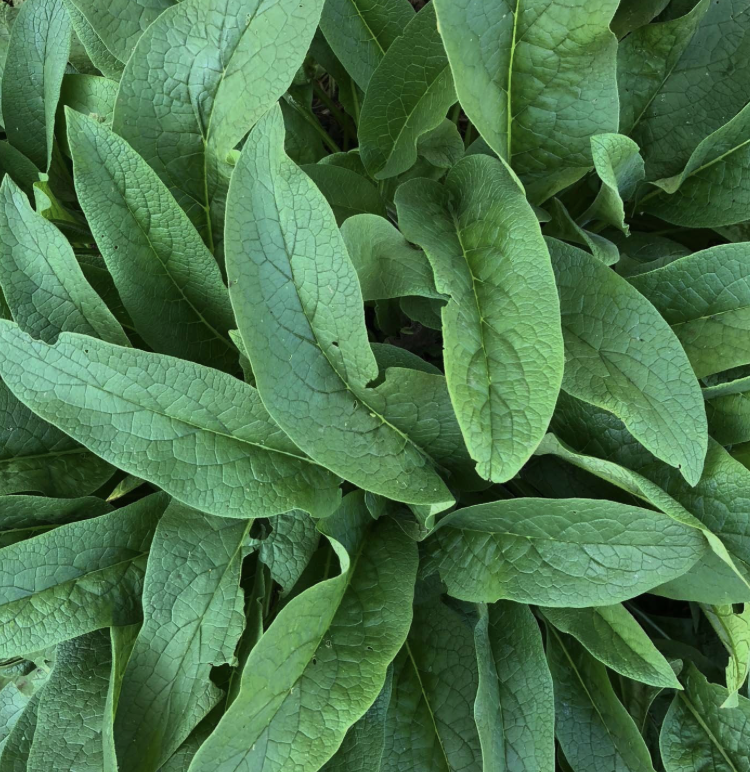
Botanical name: Symphytum officinale.
Common name: Comfrey, Boneset, Knitbone.
Family: Boraginaceae.
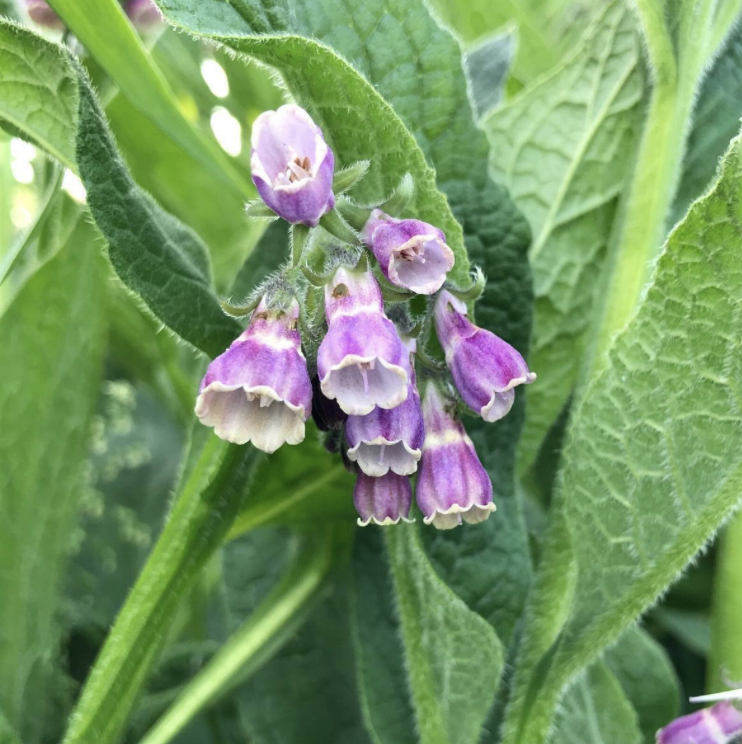
Description: Comfrey is native to Europe and Asia, and has become naturalised in many temperate regions worldwide. A perennial herb, reaching 1–1.5 m in height when in flower. The root has a thick, fleshy, black exterior with a white mucilaginous interior. The alternate leaves are 15–30cm, and lanceolate to ovate-lanceolate, deep green with lighter young growth, prominent veins and stiff hairs, and purple, pink to white bell-shaped flowers which are known to attract bees and other pollinators. It is commonly found along roadsides and riverbanks, and in fields and gardens. It grows in full sun to partial shade, and prefers rich soil and damp areas.
Parts used: Aerial parts including flowers, roots.
Energetics: Cool.
Taste: Mild, Bitter.
Constituents: Allantoin, inulin, rosmarinic, p-hydroxybenzoic, caffeic, chlorogenic and p-coumaric acids. alkaloids, amino acids, Vit C, E & B12, flavonoids, triterpenes, terpenoids, tannins, saponins, sterols, mucopolysaccharides, pyrrolizidine alkaloids (PA’s).
Actions: Analgesic, anti-inflammatory, anti-rheumatic, astringent, anti-oxidant, alterative (blood purifier), anti-hemorrhagic, demulcent, emollient, respiratory tonic, expectorant, anti-catarrhal, musculoskeletal system tonic, mucilaginous, nutritive, vulnerary (wound healing).
Folklore & traditions: Symphytum is derived from the Greek Symphyton, meaning ‘grown together’, referring to the plant's ability to heal bones and wounds. The Spanish name for Comfrey is ‘La Consuelda, with ‘suelda’ meaning to weld or to knit.
A remedy for external and internal use since Ancient times, Comfrey was valued in Medieval Europe for joint stiffness, muscular soreness, bruising, swelling, dislocations and fractures. The farmers used Comfrey roots for ointments and tinctures, and the leaves to treat sprains, joint pains joint inflammation and torn ligaments. In Romania, Comfrey was used to treat bruises, sprains, pulled muscles and ligaments, haemorrhoids, bone fractures, tendon damage, intestinal ulcers, lung congestion, and to heal wounds. As an expectorant, Comfrey is an old remedy for dry irritable cough. The leaves and roots were taken internally as infusions and tinctures for treating rheumatism and lung congestion in Mexico, gastritis and gastric ulcers in Brazil and skin problems in North America, with the roots (tea, alcoholic extract or ointment) used for arthritic pain in Lithuania and as a tonic in Jamaica.
In folklore, Comfrey is seen as a plant of protection and repair - steady, grounded, deeply rooted. Comfrey represents endurance, healing after hardship, and the strength that comes from rebuilding slowly and thoroughly. Comfrey’s thick, regenerative taproot and its ability to reshoot repeatedly from the smallest root fragment traditionally symbolise repair, resilience, and renewal.
Medicinal uses: Musculoskeletal pain, swelling & inflammation - Comfrey’s anti-inflammatory and analgesic properties are beneficial for musculoskeletal pain, both topically and internally. It is a useful remedy for strains, sprains, bruises, arthritis and gout. Comfrey is rich in the chemical constituent allantoin, which accelerates cell division rates in fibroblasts, chondroblasts and osteoblasts - decreasing the healing time of tissue, cartilage & bones. Allantoin is very penetrating which encourages cell proliferation and promotes deep healing of bruises, sprains, swelling, inflamed tendons & ligaments. dislocations and fractures, so even topical application is effective in decreasing healing time.
High in rosmarinic acid, a potent anti-inflammatory and mildly analgesic - making it an effective pain remedy when healing bruises, sprains, dislocations, swelling and fractures, and making Comfrey topically soothing for arthritis, gout and lower back pain. Traditionally applied as a poultice or compress, and infused in oils to support muscle and joint recovery following physical strain or trauma.
Skin healing - The demulcent, vulnerary, astringent and emollient properties of Comfrey make it perfect for healing cuts, burns, bruises, wounds, ulcers, insect bites, and to reduce scarring. Comfrey can be used topically for bruising of the skin, wounds, burns, displaying rapid positive impact in human skin fibroblast regeneration in studies.
Nutritive, digestive & urinary system tonic- Rich in proteins, vitamins and minerals including calcium, iron, vitamins C, E and B12, Comfrey is a source of easily assimilated nutrients. Comfrey has been utilised historically as a digestive astringent, for digestive complaints and to heal stomach ulcers. Comfrey’s high mucilage content can soothe an irritated and inflamed digestive tract, bladder and urinary tract, and its astringent properties can decrease hematuria (blood in the urine) and haemorrhoids. Used historically as a tea in Mexico for treating gastritis and gastric ulcers. (See Cautions & Contraindications below).
Respiratory system tonic -A traditional remedy for lung congestion, Comfrey has expectorant properties, and is a beneficial respiratory system tonic for catarrh, coughs and bronchitis. It’s astringent properties can decrease mild bleeding in irritated airways and the mucilage is very soothing to respiratory system irritation.
Chakra: Root.
Astrological correspondence: Saturn.
Cautions & contraindications: Contra-indicated during pregnancy and lactation, infants, people with liver conditions and people on blood thinning medications.
There is a lot of controversy over whether Comfrey is safe to take internally. This is because this herb contains pyrrolizidine alkaloids (PAs) that are potentially toxic to the liver and can induce veno-hepato-occlusive disease. Modern herbal practice is generally for external use only, and internal use is prohibited in Australia, due to the naturally occurring pyrrolizidine alkaloids. Selling or recommending Comfrey for internal consumption is prohibited / not permitted for therapeutic use in Australia or the USA.
Topical application for Comfrey include compress, oil infusion, poultice, balm, salve and soak. There is also the Homeopathic remedy, Symphytum.
Take care when using Comfrey on puncture wounds, deep or infected wounds, as the wound may heal rapidly, sealing the infection within it.
SHOP YANTRA HERBS PAIN RELIEF BALM WITH COMFREY ROOT & LEAVES HERE.
References: Ayales, Adriana. The Herbal Astrology Oracle, 2022.
Gladstar, Rosemary. Family Herbal, 2001.
Hoffmann, David, The New Holistic Herbal, 1994.
Hoffmann, David. The Herbal Handbook, A User’s Guide to Medical Herbalism, 1999.
Salehi, B. Et al, Symphytum Species: A Comprehensive Review on Chemical Composition, Food Applications and Phytopharmacology. https://pmc.ncbi.nlm.nih.gov/articles/PMC6631335/
Tierra, Michael. Planetary Herbology, 1970.
Wood, Mathew, The Earthwise Herbal. A complete guide to New World Medicinal Plants, 2011.